Pinkishe Foundation

8/11/2026
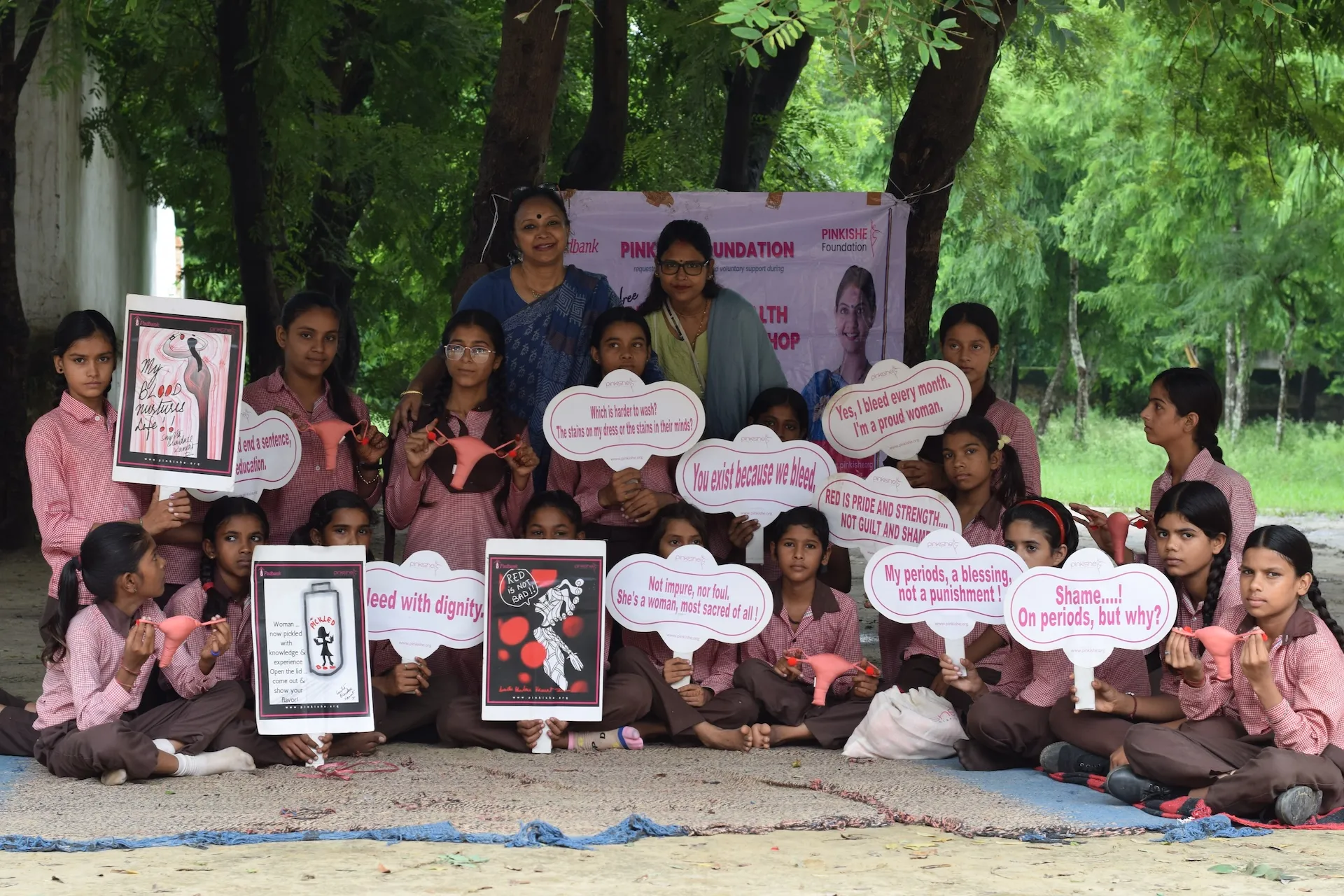
MHM is short for menstrual hygiene management. In Hindi, people often call it मासिक धर्म स्वच्छता प्रबंधन.
You may also see MHH, which stands for menstrual health and hygiene. Some people type it as "MHHM". MHH is the wider idea. It covers hygiene, and also health, knowledge, dignity and the social side of periods.
In simple words, MHM means a girl or woman can manage her period safely, privately and with dignity, every month. Not just once. Every month.
That sounds simple. In practice it needs many things to be in place at the same time. If even one is missing, the whole thing breaks.
To see how a school programme brings these pieces together, read about Shakti Shala, our school programme.
Think of MHM as a chain. Each link matters.
When people say a school "has MHM", this is what they should mean. All seven links, not one or two.
Companies that want to support this chain in schools can start with our CSR partnership page.
India has come a long way. Among women aged 15 to 24, the use of a hygienic method during the period rose from 57.6% in NFHS-4 (2015-16) to 79.2% in NFHS-6 (2023-24). That is real progress.
But 1 in 5 young women still go without a hygienic method (NFHS-6). In villages, 1 in 4 young women lack safe period products (NFHS-6).
School is where many girls meet these gaps. Most schools now have a girls' toilet: 97.3% of India's schools, says UDISE+ 2024-25. But having a toilet is not the same as being able to use one. When ASER 2024 surveyors visited rural government schools, 28% had no usable girls' toilet.
And knowledge matters as much as products. A review of 138 Indian studies found that 1 in 4 girls stayed home from school during their periods (BMJ Open, 2016).
These are national figures from public sources. They show why every link in the chain counts.
Our Shakti Shala programme is built around exactly these links in government schools.
On 30 January 2026, the Supreme Court recognised menstrual health as part of every girl's right to life under Article 21. Its directions cover classes 6 to 12. They include free sanitary pads, vending machines or other set places to get them, safe disposal, toilets with water, awareness for teachers and students, and periodic inspections. A later order, in September 2026, updated the standard for pads.
So MHM in schools is no longer only a good idea. It is now part of what every girl has a right to. The hard part is making it work every day, in every school.
Legal position as of 8 November 2026.
If your company wants to help schools meet these directions, see how a CSR partnership works.
A pad machine on the wall is a start. It is not a programme. Here is what makes MHM work in a school:
This is the model of Shakti Shala. It runs from ₹2.2 lakh a school a year, for one school, a district, or every school in it.
Pinkishe Foundation is a specialist implementation organisation for menstrual health. We deliver, reliably, in schools and communities across India.
Since 2017 we have supported over 8 lakh girls and women, and run over 6,000 menstrual health classes, in 150+ districts in 25 states and 3 union territories.
For CSR partners, every session is counted the same day. Partners see a live tracker, updated within 48 hours of a session, on every project.
If you lead CSR for a company and want to bring MHM to schools in your district, talk to us about a CSR partnership.
A simple printable sheet that marks your period days, your fertile window and your ovulation day. We will email it to you now.
We will send the tracker and a few gentle menstrual health emails from Khyati at Pinkishe. No spam, unsubscribe any time.
Prefer to work out your dates now? Open the free ovulation calculatorMHM stands for menstrual hygiene management. In Hindi it is often called मासिक धर्म स्वच्छता प्रबंधन. It means a girl or woman can manage her period safely, privately and with dignity, every month.
MHM is menstrual hygiene management: products, privacy, water, safe disposal and knowledge. MHH, sometimes typed as MHHM, is menstrual health and hygiene. It is the wider idea, and also covers health, dignity and the social side of periods.
On 30 January 2026 the Supreme Court recognised menstrual health as part of every girl's right to life. Its directions for classes 6 to 12 include free sanitary pads, vending machines or other set places to get them, safe disposal, toilets with water, awareness for teachers and students, and periodic inspections (legal position as of 8 November 2026).
₹1,100 gives one girl a year. Donations are eligible for deduction under Section 80G.