Pinkishe Foundation

31/10/2026

Most disposable pads contain plastic and take a very long time to break down. Compostable and reusable products cut that waste. Reusable ones can also save money over time.
Every safe product is a good choice. Ordinary disposable pads are safe too. The best product is the one you can get, use comfortably and keep clean. If you would like to try something kinder to the earth, here are five options.
This is also the direction India's Supreme Court has set. In its order of 1 September 2026, the Court set the standard as compostable products meeting ISO 17088 read with IS 5405, and directed states towards reusable cups, period panties and reusable napkins. (Reviewed: October 2026.)
Compostable pads look and work like ordinary pads, but are made from plant-based materials that can break down. When you buy, look for pads that say compostable and name ISO 17088 and IS 5405 on the pack. "Biodegradable" alone does not tell you much.
Change your pad every 4 to 6 hours, or sooner if it is full. Compostable pads break down only in the right conditions, so follow your local rules: wrap the used pad in paper and hand it over as sanitary waste, kept separate from wet and dry waste.
A menstrual cup is a small, soft cup, usually made of medical-grade silicone. It sits inside the vagina and collects blood instead of absorbing it. One cup can last for years, so it cuts waste a great deal.
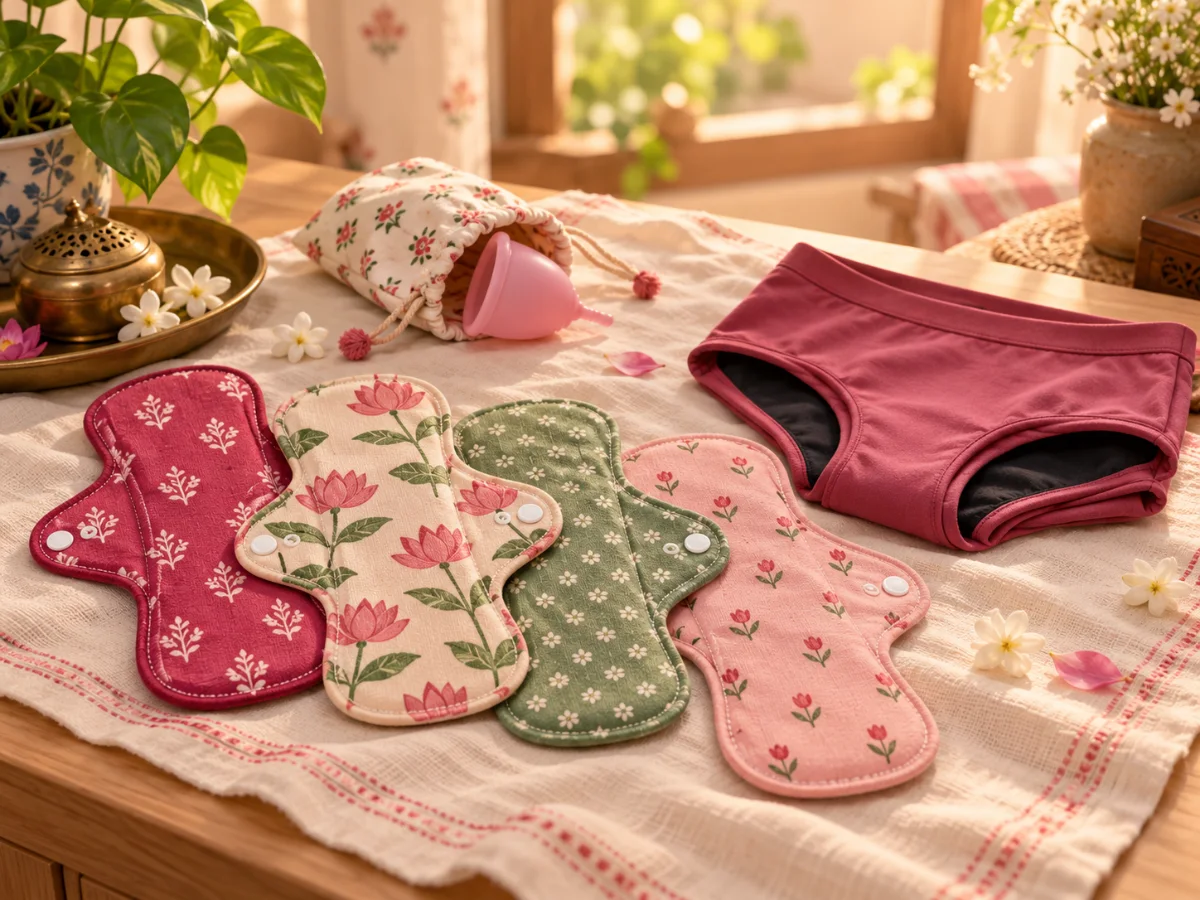
Cloth pads are reusable pads made of soft, absorbent fabric such as cotton. They come in different sizes for light and heavy days. Washed and dried well, they are a safe choice.
Period panties look like ordinary underwear but have absorbent, leak-proof layers built in. Some people wear them alone on light days, and with a pad or cup on heavy days.
Change them as often as you would change a pad. Rinse in cold water, wash with soap or as the label says, and dry fully, in sunlight where you can.
Some tampons are made from cotton without plastic, and some come without an applicator, which cuts waste further. The same safety rules apply as for any tampon.
Think about what you can wash and dry easily at home, what you feel comfortable using, and what you can buy where you live. You do not have to switch everything at once. Many people use cloth pads at home and a different product when they are out.
If you are not ready for something used inside the body, that is fine. Cloth pads and period panties are worn outside, like an ordinary pad.
Have a question about period products or your periods? Call our menstrual helpline on 85888 70999. It answers at any hour.
A simple printable sheet that marks your period days, your fertile window and your ovulation day. We will email it to you now.
We will send the tracker and a few gentle menstrual health emails from Khyati at Pinkishe. No spam, unsubscribe any time.
Prefer to work out your dates now? Open the free ovulation calculatorUse clean, soft cotton cloth. Fold or sew several layers together, and add a leak-proof layer at the bottom. Wash with soap after each use and dry fully in sunlight.
Ordinary pads, compostable pads, cloth pads, menstrual cups and period panties are all safe choices when used and cleaned properly. Choose what suits you.
It is best not to. Wrap the used pad in paper and hand it over as sanitary waste, as your local body asks.
Yes, once their periods have started and they feel ready, and someone has shown them how. Smaller sizes are available. Using a cup does not change anything about virginity.
Yes. Washed with soap and dried fully in sunlight, cloth pads are a safe, clean choice.
Compostable pads, cups, cloth pads, period panties and compostable tampons all cut waste. Each is safe when you change it on time and keep it clean. Pick what you can use comfortably.
Pinkishe Foundation is a specialist implementation organisation for menstrual health. We deliver, reliably, in schools and communities across India. Support our work with a donation.
₹1,100 gives one girl a year. Donations are eligible for deduction under Section 80G.