Menstrual Cups: How to Choose, Use and Care for One

Person Icon

Pinkishe Foundation

Calendar Icon

31/10/2026

Dr. Shehla Jamal

Menstrual Cups: How to Choose, Use and Care for One

What is a menstrual cup?

A menstrual cup is a small, soft, bell shaped cup, usually made of medical grade silicone. You fold it and put it into your vagina, where it opens and collects period blood. You take it out, empty it, rinse it and put it back. One cup can be used for several years if you look after it.

Why some girls and women choose a cup

  • Less waste. One cup replaces many disposable pads.
  • Lower cost over time. You buy it once, not every month.
  • Fewer changes. A cup holds more than most pads, so you can go longer between changes.
  • Freedom to move. You can walk, play sport, swim and sleep with it in.

A cup is not the only good choice. Disposable pads, tampons and cloth pads washed with soap and dried in sunlight are all safe. Use what suits your body and your life.

Is a cup right for me?

Most girls and women can use a cup, including teenagers once periods have started. Using a cup has nothing to do with virginity, which is not a medical idea. Start with a small size and take your time.
  • If you have a Copper-T, talk to your doctor before using a cup, and always break the seal fully before removing it.
  • If you are allergic to latex, choose a silicone cup.
  • After giving birth, wait until your doctor says it is fine to use a cup.
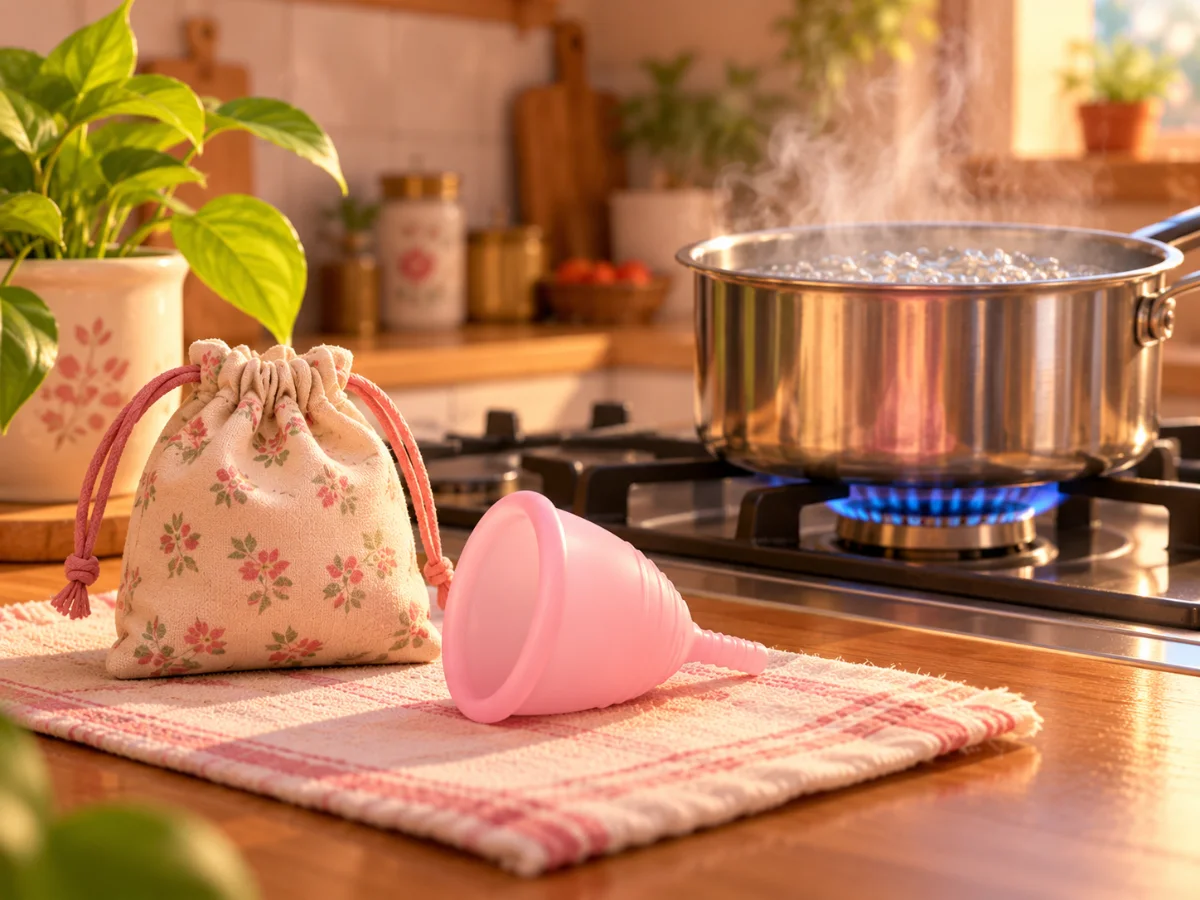
A menstrual cup in a cotton pouch beside a steel pot of boiling water.

Choosing a cup

Choose a cup from a well known maker, made of medical grade silicone, in the size that suits your age and flow. Each maker's sizes are a little different, so read their size guide.

  • Size. Smaller cups usually suit teenagers and those who have not given birth. Larger cups usually suit those who have given birth or have a heavy flow.
  • Softness. Softer cups are easier to fold and can feel gentler. Firmer cups open more easily once inside.
  • Length. If your cervix sits low, a shorter cup may be more comfortable.

Ask your gynaecologist if you are unsure.

How to use a cup

  1. Wash your hands with soap and water.
  2. Fold the cup. Try the C fold (press it flat and fold it in half) or the punch down fold (push one side of the rim down inside the cup). The punch down fold makes a smaller tip.
  3. Get comfortable. Squat, sit on the toilet or raise one foot on a step. Relax your muscles.
  4. Put it in. Gently part the labia and slide the folded cup in, pointing towards your lower back, not straight up.
  5. Let it open. Run a finger round the cup, or turn it gently, to check it has opened fully. If it has, it will stay in place. You should not feel it.

Emptying and taking it out

Empty your cup at least every 12 hours, and more often on heavy days. To take it out, wash your hands, then pinch the base of the cup to break the seal. Do not pull by the stem alone. Ease it out slowly, keeping it upright, and empty the blood into the toilet.

Keeping your cup clean

  • During your period, rinse the cup in clean water before you put it back. Use a mild, unscented soap if the maker's guide says so.
  • If there is no clean water nearby, wipe the cup with clean toilet paper and wash it properly at the next chance.
  • At the end of each period, boil the cup in a pan of water for a few minutes, or clean it as the maker's guide says.
  • Store it dry in a cloth pouch that lets air in, not a closed box or plastic bag.
  • Replace the cup if it cracks, tears, becomes sticky or smells even after cleaning.

Common problems

It leaks

The cup may not have opened fully, or may be too full. Check the seal, empty it more often, or try a different size.

It hurts or feels uncomfortable

The cup may be sitting too high or too low, or may be the wrong size. Take it out and try again. If it still hurts, stop and see a doctor.

I cannot get it out

Stay calm. It cannot get lost inside you. Relax, squat, and gently bear down as if passing a stool. This brings the cup lower. Then pinch the base to break the seal. If you still cannot remove it, see a doctor.

Staying safe

Toxic shock syndrome (TSS) is very rare with cups, but it can happen. Empty your cup at least every 12 hours, wash your hands first, and remove it and see a doctor at once if you get a sudden fever, rash, vomiting or feel faint.

When to see a doctor

  • You get a sudden high fever, rash, vomiting, diarrhoea, or feel faint or dizzy while using a cup. Remove it and get help at once.
  • You have pain, itching or unusual discharge with a bad smell.
  • You cannot remove the cup.
  • The cup hurts every time, even after trying a different size.
  • You have a Copper-T and think the threads may have moved.
  • Your periods are very heavy or last more than seven days.

Have a question about cups or your period? Call our menstrual helpline on 85888 70999. It answers at any hour.

Get the free three month period tracker

A simple printable sheet that marks your period days, your fertile window and your ovulation day. We will email it to you now.

Thank you! Your submission has been received!
Oops! Something went wrong while submitting the form.

We will send the tracker and a few gentle menstrual health emails from Khyati at Pinkishe. No spam, unsubscribe any time.

Prefer to work out your dates now? Open the free ovulation calculator

FAQs

Can teenagers use a menstrual cup?

Yes, once periods have started. Start with a small size and take your time. It can take a few periods to get used to it.

Can I use a cup if I am a virgin?

Yes. Using a cup has nothing to do with virginity, which is not a medical idea. Start with a small size and take your time.

How often should I empty my cup?

At least every 12 hours, and more often on heavy days.

Can I sleep with a cup in?

Yes, as long as you empty it at least every 12 hours. Empty it just before bed and as soon as you wake.

Can I swim or exercise with a cup?

Yes. Once it has opened fully, it stays in place while you move.

Is a cup safe?

Yes, for most girls and women, when you keep it clean and empty it at least every 12 hours. TSS is very rare but possible, so know the warning signs.

In short

A menstrual cup is a reusable, low waste choice that many girls and women find comfortable. Choose a medical grade silicone cup in the right size, keep it clean, empty it at least every 12 hours, and know the warning signs of TSS.

About Pinkishe Foundation

Pinkishe Foundation is a specialist implementation organisation for menstrual health. We deliver, reliably, in schools and communities across India. Support our work with a donation.

Learn more

Before you go

Right now, a girl in India is missing school because of her period.

Not because she wants to. Because she has a torn piece of an old saree and nobody has ever explained her own body to her. You just read an article about yours. ₹1,100 covers one girl's menstrual protection, education and support for a year.

Donate ₹1,100 for one girl's year

Eligible for deduction under Section 80G. Receipt emailed instantly · Giving from outside India?

8 lakh+Girls and women supported since 2017
6,000+Menstrual health classes
12AB and 80GFCRANSE Social Stock Exchange5★ on Google from over 2,400 people

₹1,100 gives one girl a year. Donations are eligible for deduction under Section 80G.

Donate Now

Read Other Blog Posts