Pinkishe Foundation

31/10/2026
Dr. Shehla Jamal

Many parents feel that girls today start their periods younger than they did. They are right. Studies in many countries, India included, show girls starting their periods a little earlier than a generation ago. This guide explains why, what it can mean, and how to help your daughter feel ready.
Most girls get their first period between about 10 and 15. It usually comes about two years after the breasts start to develop. Every girl is different.
Puberty that starts very early is a reason to see a paediatrician. Take your daughter to one if her breasts start to develop before age 8, or if her first period comes before age 10. Sometimes there is a medical cause that needs treatment. Puberty that starts too early can also make a girl stop growing sooner, so a doctor's check is worth it.
Girls often start their periods at about the same age as their mother did.
Better nutrition is good news. But higher body weight in childhood is linked with earlier puberty, because body fat plays a part in the hormones that start it.
Some chemicals in plastics and cosmetics may affect hormones. Research is still going on. Simple steps, such as not heating food in plastic, are sensible.
Some studies link long-term stress in childhood with earlier puberty.
A girl who starts before her friends may feel awkward, alone or embarrassed. Her body may change before she feels ready for it. She may also face teasing or unwanted attention.
A girl who does not know what to expect, or has nowhere to change at school, may stay at home during her period. Being prepared helps her keep going to class.
Studies link an early first period with a slightly higher risk of some conditions later in life, such as breast cancer and heart disease. For any one girl, the extra risk is small. Healthy habits through life help.
Do not wait for the first period. Start simple talks about growing up well before it, even from age 7 or 8. Keep it calm and matter of fact, so she knows a period is normal and nothing to fear.
Tell her what a period is, how long it lasts, and what to use. Show her a pad and how it works. Pads, cloth pads washed with soap and dried in sunlight, and period panties are all good choices for a young girl. Our guide to busting menstrual myths and our menstrual quiz can help you both.
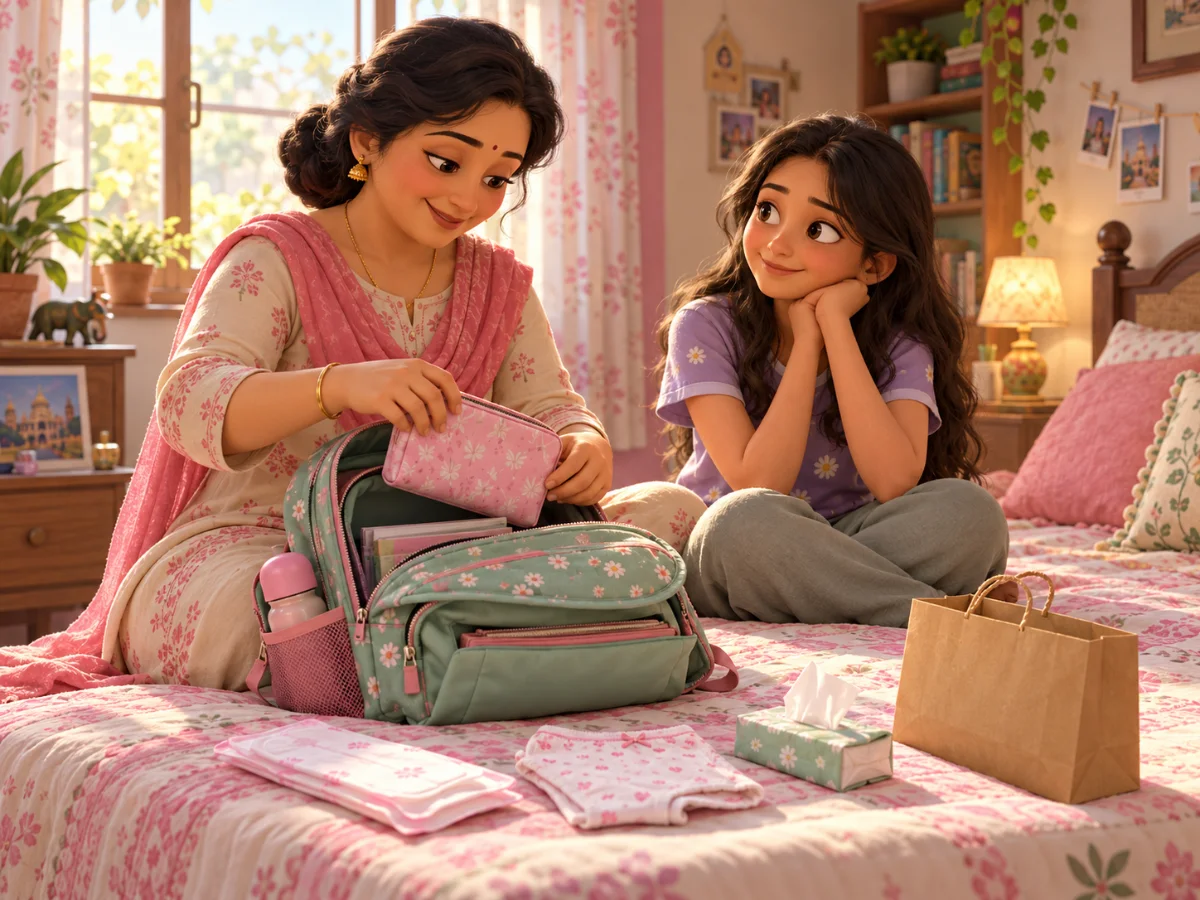
A pad or two, spare underwear and a small bag in her school bag means she will not be caught out.
Encourage home-cooked meals, fruit and vegetables, and plenty of active play. Do not put a child on a diet. If you are worried about her weight, talk to a paediatrician.
Find out whether there is a clean toilet with water, and a teacher she can go to if her period starts in class.
Her body is growing as it should. Praise her for asking questions, and keep answering them.
Have a question about your daughter's periods? Call our menstrual helpline on 85888 70999. It answers at any hour.
A simple printable sheet that marks your period days, your fertile window and your ovulation day. We will email it to you now.
We will send the tracker and a few gentle menstrual health emails from Khyati at Pinkishe. No spam, unsubscribe any time.
Prefer to work out your dates now? Open the free ovulation calculatorMost girls get their first period between about 10 and 15, usually about two years after their breasts start to develop.
It is earlier than usual. If your daughter's period starts before 10, or her breasts start to develop before 8, take her to a paediatrician to check that all is well.
There is no sure way to delay puberty. Healthy meals and active play are good for her at any age. If there is a medical cause, a doctor can advise on treatment.
Stay calm and reassure her. Make sure she knows what is happening and has what she needs. If she is younger than 10, see a paediatrician.
Studies link an early first period with a slightly higher risk of breast cancer and heart disease later in life. For any one girl the extra risk is small, and healthy habits help.
Girls are starting their periods a little earlier than a generation ago. Talk to your daughter early, help her feel prepared, and see a paediatrician if puberty starts before 8 or her period comes before 10.
Pinkishe Foundation is a specialist implementation organisation for menstrual health. We deliver, reliably, in schools and communities across India. Support our work with a donation.
₹1,100 gives one girl a year. Donations are eligible for deduction under Section 80G.