Pinkishe Foundation

31/10/2026
Dr. Shehla Jamal

Yes. For most girls and women, mild to moderate period pain can be eased at home. Heat, gentle movement, rest and good food all help. A painkiller can help too. You will find more about this below.
Some pain during periods is common. But strong pain is not something you must quietly put up with. If cramps keep you away from school, college or work, please see a doctor. There is often a cause that can be treated.
During your period, the womb (uterus) tightens to push out its lining. Natural chemicals in the body, called prostaglandins, make it squeeze. This squeezing causes cramps in the lower tummy. The ache can spread to the lower back and thighs.
Cramps often start just before bleeding or on the first day. They are usually worst in the first one or two days, and then ease.
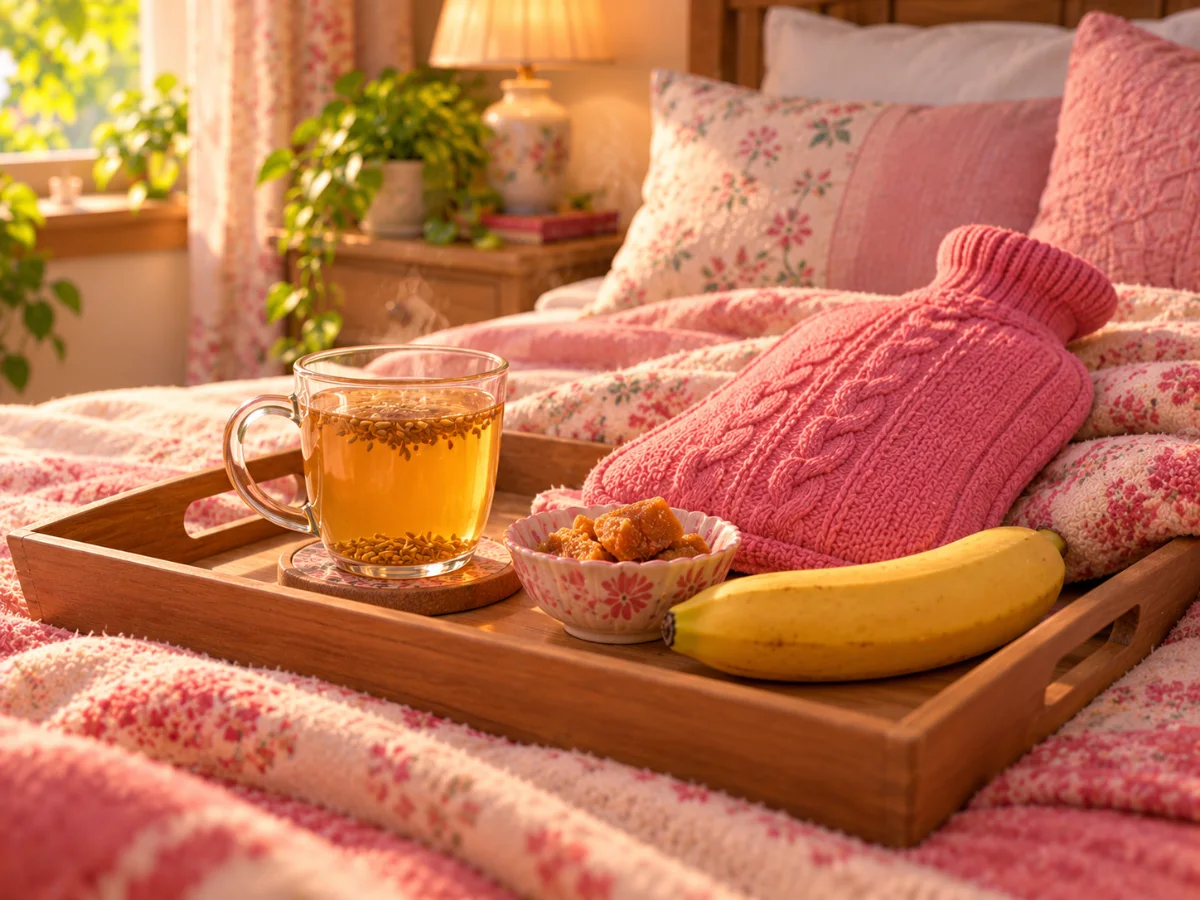
Heat relaxes the muscles of the womb and eases cramps. Place a hot water bottle or a heating pad on your lower tummy or lower back. Wrap it in a towel so it does not burn your skin. Do not fall asleep with a very hot bottle on your body.
A warm bath relaxes your whole body and can ease cramps. It is safe to bathe and wash your hair during your period. The idea that you should not is an old myth. You can read more on our page of menstrual myths and facts.
Light exercise can ease cramps and lift your mood. Try a short walk, slow stretching or gentle yoga. You do not need to push hard. Even ten minutes can help.
Pain feels worse when your body is tense. Sit or lie down comfortably. Breathe in slowly through your nose, then breathe out even more slowly. Keep going for a few minutes. Simple meditation or a quiet prayer can calm the mind in the same way.
Rub your lower tummy slowly in small circles. Use a little coconut oil so your hands move easily. Some girls and women like to add a drop or two of lavender oil for its calming smell. Treat this as comfort, not a cure. Test the oil on a small patch of your inner arm first, and keep oils away from the vagina.
Good food helps your body cope. Fill your plate with fresh fruit, vegetables, whole grains and protein such as dal, rajma, chana, curd and eggs. Iron-rich foods like palak, methi, ragi and chana help replace the iron you lose in period blood. Have amla, lemon or guava with them to help your body take in the iron.
Some studies suggest that omega-3 fats may ease cramps a little. You will find them in alsi (flaxseed), walnuts and fish such as rohu or bangda.
Drink water through the day. Coconut water, chhachh and nimbu pani are good too. Try to cut down on strong tea, coffee and cola during your period. Some girls and women find these make bloating or cramps feel worse.
Pain is harder to bear when you are tired. Try to go to bed at the same time each night and get a full night's sleep. Lying on your side with your knees drawn up, or on your back with a pillow under your knees, can ease the pull on your tummy.
Taking your mind off the pain helps. Watch a film, listen to music, read, draw or chat with a friend. It will not stop the cramps, but it can make them easier to get through.
You do not have to manage alone. Tell your mother, a sister, a friend or a teacher how you feel. Ask for a little help on the hard days.
Some girls and women feel low, tearful or irritable around their periods. If these feelings are strong, or they last beyond your period, talk to a doctor.
If you ever feel hopeless or have thoughts of harming yourself, please talk to someone today. Call Tele-MANAS, the government's free mental health helpline, on 14416 or 1-800-891-4416, at any hour. In an emergency, call 112.
Yes. Taking a painkiller for period pain is safe for most people, and it is not a sign of weakness. It usually works best when you take it as soon as the cramps begin. Ask a doctor or pharmacist which painkiller is right for you and how much to take. Tell them your age, as some painkillers are not suitable for children and young teenagers. Always read the label.
If you have asthma, stomach problems or kidney problems, or you could be pregnant, check with a doctor before taking any painkiller.
For strong pain, a doctor may also suggest other treatments, including some hormonal ones, that make periods less painful. A doctor can tell you what suits you.
Write down the day your period starts, how long it lasts and how bad the pain is each month. This helps you see a pattern, and it helps a doctor understand what is going on. Our period and ovulation calculator can help you work out when your next period may come, so you can keep a hot water bottle ready.
Strong period pain can sometimes come from conditions such as endometriosis or fibroids. These can be treated, so it is worth getting checked.
Have a question about period pain? Call our menstrual helpline on 85888 70999. It answers at any hour.
A simple printable sheet that marks your period days, your fertile window and your ovulation day. We will email it to you now.
We will send the tracker and a few gentle menstrual health emails from Khyati at Pinkishe. No spam, unsubscribe any time.
Prefer to work out your dates now? Open the free ovulation calculatorMild to moderate cramps in the first day or two of a period are common. Pain that stops you from going to school or work, or that a painkiller does not ease, is not normal. Please see a doctor about it.
Yes. Heat on the lower tummy or lower back relaxes the muscles of the womb and eases cramps for many girls and women. Wrap the bottle in a towel so it does not burn your skin.
Yes. Gentle exercise such as walking, stretching or yoga is safe during your period and can ease cramps. Go at your own pace and rest if you feel tired.
There is no single food that stops cramps. A balanced diet with dal, chana, rajma, palak, ragi, fruit and vegetables keeps your body strong and helps replace iron. Some studies suggest omega-3 fats in alsi, walnuts and fish may help a little.
For most people, taking a painkiller as directed on period days is safe. Ask a doctor or pharmacist which one is right for you. If you need painkillers for more than a few days each month, or they stop working, see a doctor.
Marriage does not change period pain. Some women find their cramps ease as they get older or after having a baby, but not everyone does. Do not wait for either. If your pain is strong, see a doctor now.
Period pain is common, and simple steps like heat, gentle movement, rest and good food can ease it. A painkiller is fine too; ask a doctor or pharmacist which one suits you. If pain stops you from living your life, see a doctor, because there is often a treatable cause.
Pinkishe Foundation is a specialist implementation organisation for menstrual health. We deliver, reliably, in schools and communities across India. Support our work with a donation.
₹1,100 gives one girl a year. Donations are eligible for deduction under Section 80G.