Pinkishe Foundation

31/10/2026

Yes. Every period product leaves something behind: used pads, wrappers, packets. You do not have to change everything at once, and you never have to give up a product that works for you. Small habits add up, and the most useful ones are about how you care for products and how you throw them away.
Here are five of them. If you want a side-by-side look at the products first, read our guide to eco-friendly period products.
Reusable products are used for many periods, so far less goes in the bin. The main options are cloth pads, menstrual cups and period underwear. Many people mix and match, for example a cloth pad at home and a disposable pad on a long day out.
There is no right answer. The best product is the one you can use comfortably, change on time and keep clean. If a reusable product is not right for you, the other four habits still help. To compare options, see which period product is right for you.
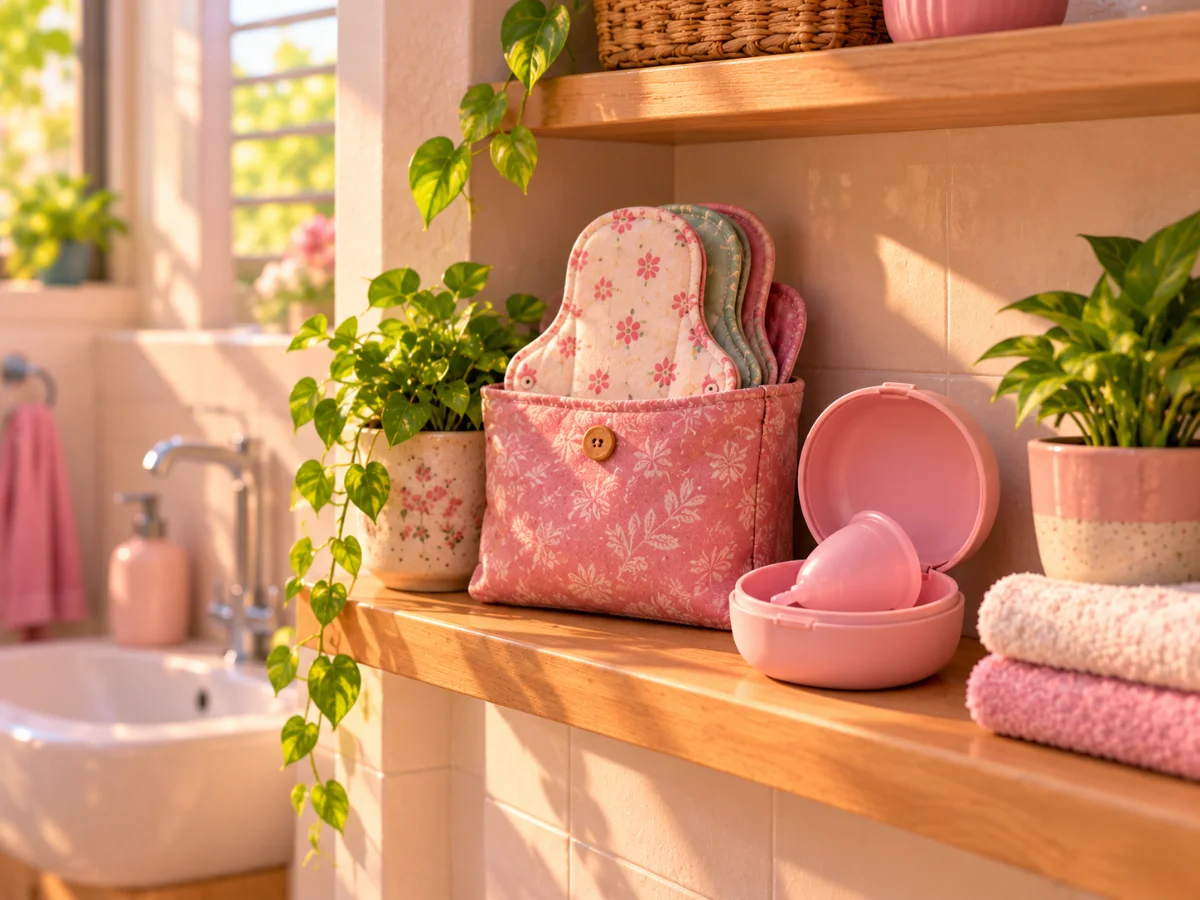
A reusable product only saves waste if it lasts, and it is only safe if it is kept clean.
Cloth pads are safe when they are washed with soap and dried fully in sunlight.
Disposable pads are safe, easy to use and the right choice for many girls and women. If you use them and want less waste:
This is the standard the Supreme Court has set. On 30 January 2026, in Dr Jaya Thakur v Government of India, the Supreme Court held that menstrual health is part of the right to life under Article 21. It gave directions for classes 6 to 12 on free products, vending machines, safe disposal, education, teacher training and annual inspection. In an order of 1 September 2026, the Court set the standard as compostable products meeting ISO 17088 read with IS 5405, and directed states towards reusable cups, period panties and reusable napkins.
Period waste is easier to handle when people talk about it. Ask your school, college, office or housing society for a covered bin for sanitary waste in every girls' and women's toilet. Ask your local body how it collects sanitary waste in your area. Share what works for you with friends, sisters and daughters. Periods are normal, and so is talking about what to do with the waste.
For more on the myths that make this hard to talk about, see our menstrual myths and facts.
Last reviewed: October 2026.
Have a question about greener periods? Call our menstrual helpline on 85888 70999. It answers at any hour.
A simple printable sheet that marks your period days, your fertile window and your ovulation day. We will email it to you now.
We will send the tracker and a few gentle menstrual health emails from Khyati at Pinkishe. No spam, unsubscribe any time.
Prefer to work out your dates now? Open the free ovulation calculatorStart small. Try one reusable product on lighter days, care for it well, and throw away disposable products the right way: wrapped in paper and handed over as sanitary waste.
Yes. Cloth pads are safe when they are washed with soap and dried fully in sunlight. Change them every 4 to 6 hours and replace them when they wear thin.
Wash your hands, empty the cup at least every 12 hours and rinse it with clean water. At the end of each period, boil it in plain water as the pack instructs, dry it and store it in a cotton pouch.
No. Even compostable pads should be wrapped in paper and handed over as sanitary waste, kept separate from wet and dry waste, as your local body asks.
Look for compostable, meeting ISO 17088 and IS 5405 on the pack. This is the standard the Supreme Court set in its order of 1 September 2026. Vague words like "eco" do not tell you much.
You can cut period waste without giving up the product that suits you. Care for reusables well, read the label on disposables, and always hand over used pads wrapped in paper as sanitary waste.
Pinkishe Foundation is a specialist implementation organisation for menstrual health. We deliver, reliably, in schools and communities across India. Support our work with a donation.
₹1,100 gives one girl a year. Donations are eligible for deduction under Section 80G.